Quick Definition
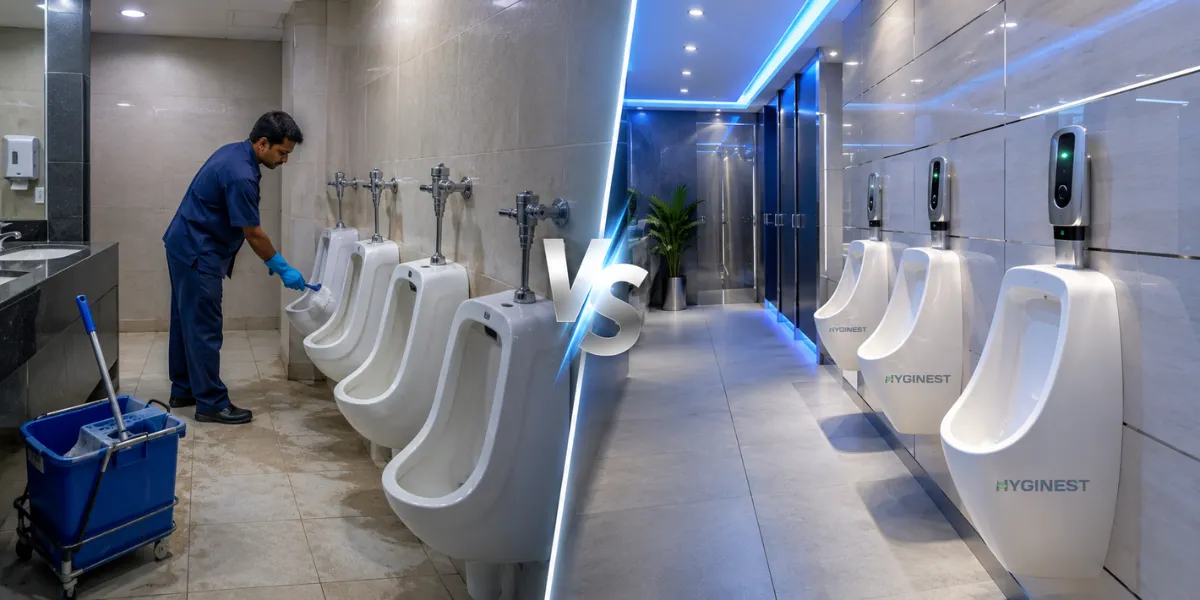
Automatic Urinal Flusher: A sensor-activated valve – using infrared (IR) or passive infrared (PIR) detection – that flushes a urinal when a user steps away, without any physical contact. Per the Indian Plumbing Association’s NBC-aligned fixture standards, urinals in India are rated at a maximum of 3.8 litres per flush at 4 bar pressure. Both automatic and manual flush valves must meet this limit; the difference is that automatic valves enforce it consistently, while manual valves rely entirely on user behaviour.For most commercial restrooms in India, an automatic urinal flusher outperforms a manual valve on hygiene, consistency, and long-term operational value. Manual flush valves cost less upfront but create three recurring problems: users skip flushing, the handle becomes a high-risk cross-contamination surface, and there is no mechanism to prevent over-pressing and excess water use. Facilities with consistent daily male footfall – offices, malls, hospitals, hotels – gain a clear return from automatic flushers, provided inlet water pressure meets the minimum required for sensor valve operation.
What Is an Automatic Urinal Flusher and How Does It Work?
An automatic urinal flusher is a sensor-controlled valve that replaces the manual flush lever or button on a urinal’s inlet pipe. Most units use one of two detection technologies: active infrared (IR) sensors that emit and detect a reflected beam, or passive infrared (PIR) sensors that detect body heat. When the sensor detects a user departing, the valve opens for a single calibrated flush – one activation per visit, regardless of how long the user was present.
Power options split into battery-operated (typically 4 AA batteries) and hardwired AC-powered units. Battery models suit retrofits in existing buildings where running an electrical circuit to the urinal is impractical. AC-powered models work best in new construction where a power circuit is already planned at the fixture location. Hyginest supplies both configurations for Indian commercial environments, from corporate office blocks to pharmaceutical-grade facilities.
How Do Automatic and Manual Urinal Flushers Actually Differ?
The core difference is activation method – but that single difference creates downstream effects across hygiene, water consistency, and operational reliability. The table below compares both types across the factors that matter most for Indian commercial facility managers.
| Factor | Automatic Flusher | Manual Flusher |
|---|---|---|
| Touchless operation | Zero contact required | Handle or button pressed every use |
| Flush volume (IPA/NBC standard) | 3.8 L – sensor-enforced, one activation | 3.8 L rated – no control over actual use |
| Flush consistency | Every departure triggers a flush | User-dependent – frequently skipped |
| Phantom flush risk | Possible with poor sensor calibration | None – purely mechanical |
| Upfront cost (India, approx.) | ₹2,500–₹8,000 per unit | ₹400–₹1,500 per unit |
| Maintenance | Battery or power check required | Low – purely mechanical |
| Cross-contamination risk | Very low – no shared touch point | High – handle shared across all users |
| Green building certification (IGBC/GRIHA) | Supports water-efficiency credits | Compliant, but no rating advantage |
| Best suited for | Hospitals, offices, malls, airports, hotels | Very low-traffic or extreme budget sites |
Does an Automatic Urinal Flusher Actually Save Water?
The honest answer: it depends on calibration quality. The Alliance for Water Efficiency – a leading US-based water efficiency research body – cites the landmark 2010 Gauley and Koeller study, which found that sensor toilet flush valves increased water consumption by 54% in a major commercial office building due to phantom flushes. For urinals, however, the same study found water use dropped when sensors replaced manual valves.
The reason the urinal result differs from the toilet result: urinal users in shared commercial spaces frequently skip manual flushing – meaning the automatic valve guarantees a flush where none occurred before. A well-calibrated sensor set at 25–35 cm from the bowl edge fires once per user departure with no phantom triggers. A poorly calibrated unit wastes water. The fixture is not the deciding variable – installation quality and sensor placement are.
Which Commercial Facilities in India Benefit Most from Sensor Urinal Flushers?
High-traffic, hygiene-sensitive environments gain the clearest return. The automatic flusher earns its cost premium where three conditions apply together: daily urinal traffic is consistent and substantial, hygiene standards are non-negotiable, and building managers face a verifiable water cost per kilolitre.
The strongest use cases in India are hospitals and clinics, pharmaceutical manufacturing plants, food processing facilities, malls and multiplexes, corporate office blocks with 50+ male employees, airport terminals, and hotel restrooms. Low-traffic sites – a small site office, a boutique retail unit – remain genuine candidates for manual valves. The hygiene case exists at any scale; the financial payback is what varies by footfall. Browse the full range of urinal sensors and automatic flushers matched to different Indian facility types.
In Hyginest’s work with commercial clients across Gujarat and Maharashtra – including pharmaceutical plants and large-format retail chains – the most common reason automatic unit pilots underperform expectations is incorrect sensor range calibration at installation, not product quality. A sensor set beyond 40 cm pickup range generates phantom flushes; a sensor set too close misses some activations. A proper site check takes under 10 minutes and prevents both failure modes.
What Are the Most Common Mistakes When Installing Automatic Urinal Flushers?
The first mistake is fitting battery-operated units in very high-traffic venues without a battery maintenance schedule. At 150–200 flushes per day – typical for a busy mall or airport restroom – alkaline AA batteries deplete in 4–6 months. When batteries die, flushing stops, which defeats the entire purpose of the installation. Lithium batteries extend life by 30–40% and perform significantly better in the hot, humid conditions across India from April to September.
The second mistake is skipping a water pressure check before specification. Automatic sensor flush valves require a minimum dynamic inlet pressure of 0.5–1.0 bar to operate reliably. Many older commercial buildings in India – particularly those running on overhead tank-fed gravity plumbing – deliver only 0.2–0.4 bar at the urinal inlet. Fitting an automatic valve at that pressure produces incomplete flushes. A booster pump resolves the problem but must be costed before installation. Hyginest’s washroom hygiene solutions process includes a site pressure check for this reason.
How Do Bengaluru’s 2025 Water Tariffs Affect the Cost Case?
BWSSB revised its domestic water tariffs in April 2025 – the first revision in 11 years. The new domestic slab rates run from ₹7 per kilolitre (0–8 KL) to ₹50 per kilolitre (above 50 KL), per the official BWSSB Karnataka tariff schedule. Commercial properties pay higher rates than domestic, and sewerage charges are levied at 25% of water charges on top. Bengaluru is also one of India’s most water-stressed cities, with the BWSSB announcing an automatic 3% annual tariff increase from April 2026 onward.
At ₹50 per kilolitre and above, each litre wasted through phantom flushes or uncontrolled manual presses costs a measurable amount per day across a restroom block. For a 10-urinal office restroom running 80 flushes per urinal daily, one unnecessary 3.8-litre phantom flush per urinal per day adds up to 13,870 litres – nearly 14 KL – of preventable waste per month. At Bengaluru’s upper tariff rate plus sewerage charge, that is approximately ₹875 in avoidable monthly cost from phantom flushes alone.
Should You Pair Automatic Urinal Flushers with Other Touchless Fixtures?
Yes – and the hygiene logic is straightforward. Fitting automatic urinal flushers while retaining manual basin taps and soap dispensers creates an incomplete hygiene chain. Any cross-contamination risk removed at the urinal handle is partially re-introduced at the tap handle 30 seconds later. Touchless washroom design works best as a system.
The highest-impact combination for an Indian commercial restroom is: automatic urinal flusher + sensor basin tap + touchless soap dispenser + automatic hand dryer. Each shared touch point removed multiplies the protective value of the others. A sensor tap is the natural complement to an automatic flusher in any fully touchless restroom specification.
Frequently Asked Questions
What is the standard flush volume for urinals in India under NBC norms?
The Indian Plumbing Association (IPA), in its NBC-aligned fixture reference, specifies that urinals shall consume no more than 3.8 litres per flush at 4 bar pressure. This is the rated limit under the National Building Code. Automatic sensor valves are engineered to deliver this volume – one activation per user departure. Manual valves carry the same rated limit but rely entirely on user behaviour for actual compliance.
Do automatic urinal flushers always save water compared to manual ones?
Not automatically. Research compiled by the Alliance for Water Efficiency – including the 2010 Gauley and Koeller two-year fixture replacement study – found that sensor flush valves for toilets increased water consumption by 54% in one US commercial building due to phantom flushes. For urinals specifically, the same study found water use dropped, because manual urinal flushing is frequently skipped in shared commercial settings. The determining factor is sensor calibration quality, not the sensor technology itself.
Can automatic urinal flushers be retrofitted to existing urinals in Indian buildings?
In most cases, yes. Sensor flush valves replace the existing manual flush valve on the urinal’s inlet pipe. Standard Indian plumbing uses 15mm or 20mm BSP threaded connections, which most automatic valves accommodate directly. A licensed plumber can complete a single-unit retrofit in under 30 minutes without disturbing the existing fixture, tiling, or water supply line.
How do rising water tariffs in Indian cities affect the case for automatic flushers?
Significantly in water-stressed cities. BWSSB revised Bengaluru’s water tariffs in April 2025 – the first revision in 11 years – with high-volume domestic consumption now billed at ₹50 per kilolitre, plus sewerage charges at 25% of water charges. Commercial properties pay higher rates. With a 3% automatic annual increase confirmed from April 2026, the cost of preventable water waste from phantom flushes or skipped manual flushes grows each year. Facilities in Bengaluru, Chennai, and other water-scarce cities gain the fastest financial return from automatic urinal flushers.
Do automatic urinal flushers help with IGBC or GRIHA green building ratings in India?
Yes. Both IGBC’s Green New Buildings and Green Factory Building rating systems – published by the Indian Green Building Council under the Confederation of Indian Industry – award credits for water-efficient plumbing fixtures. Sensor-activated flush valves that meet NBC flow rate benchmarks qualify under indoor water use efficiency credits. GRIHA, governed by TERI and the Ministry of New and Renewable Energy, applies equivalent criteria. Projects pursuing certification should document fixture flow rates at 4 bar pressure, as required by IGBC’s Green Factory Building v2.0 (April 2025).
What is the main operational risk of automatic urinal flushers in Indian buildings?
The primary risk is power or battery failure. If batteries deplete across a restroom block without a maintenance schedule in place, all sensor valves stop functioning simultaneously – and flushing stops with them. Manual valves have no equivalent failure mode. This risk is entirely manageable: battery checks every 6 months at high-traffic sites (150+ flushes per urinal per day) and every 12 months at moderate-traffic sites. Lithium batteries reduce failure frequency at high-traffic venues and perform better in summer humidity. The maintenance schedule must be assigned to a named person before installation, not after a failure event.
The Right Choice Comes Down to Traffic, Pressure, and Standards
For most commercial restrooms in India – offices, healthcare facilities, hospitality venues, retail spaces – an automatic urinal flusher is the stronger long-term specification. The hygiene benefit begins immediately: no shared touch point, consistent flushing every single use, and a measurable signal to building occupants that hygiene standards are actively maintained.
Manual flush valves remain rational only where daily urinal traffic stays very low or where the building’s inlet water pressure falls below the minimum required for sensor valve operation. In pressure-limited buildings, the correct sequence is: diagnose the pressure shortfall, add a booster pump if feasible, then specify automatic flushers – not the reverse.
The next step takes two minutes: measure dynamic water pressure at the urinal inlet, estimate daily male footfall, and confirm whether IGBC or GRIHA certification is a project target. Those three data points determine the right specification and prevent the most common and costly installation mistakes before they happen.
Get the Right Flusher for Your Facility
Hyginest supplies automatic urinal sensors and flush valves for commercial restrooms across India – with site assessment and installation support included.
Explore Urinal Sensors & Flushers →