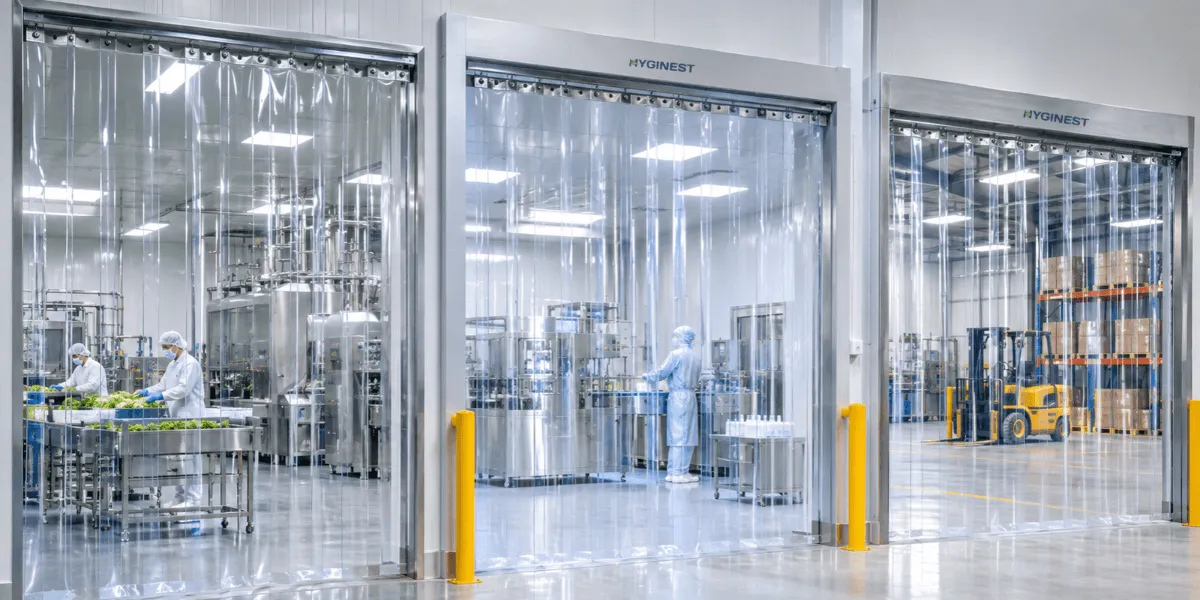
PVC strip curtains are widely used in food processing plants, pharmaceutical manufacturing facilities, warehouses, cold storage units, and industrial premises. They provide a flexible barrier that helps control dust, reduce unwanted air exchange, support hygiene practices, and allow the convenient movement of people and materials.
However, selecting the right PVC strip curtain involves more than choosing a colour or size. Door dimensions, application requirements, PVC strip quality, mounting bracket material, and plasticizer formulation all play an important role in its performance and service life.
In this guide, Hyginest Industries explains the key factors to consider when selecting the right PVC strip curtain for your facility.
1. Identify the Application and Measure the Door
The first step is to understand how the doorway is used and measure its dimensions accurately.
A. Identify the Door Application
Different applications require different PVC strip curtain specifications.
- Regular Use: General factory entrances, warehouses, production areas, and internal partitions.
- Cold Room / Freezer: Chillers, cold storage facilities, and frozen food processing areas.
- Loading / Unloading Dock: Areas with frequent movement of trucks, forklifts, pallet trucks, and large trolleys.
- Insect-Control Areas: Bakeries, cake factories, chocolate manufacturing units, and food processing facilities where insect entry is a concern.
B. Understand Door Dimensions
Door height and width help determine the appropriate PVC strip curtain specifications.
| Door Parameter | Importance |
| Door Height | Helps determine the suitable PVC strip thickness and weight |
| Door Width | Helps calculate the required strip quantity, width, and overlap |
| Traffic Movement | Helps determine strip type, thickness, and durability requirements |
| Operating Temperature | Determines whether standard or low-temperature PVC is suitable |
Important: The final strip specifications should be selected according to the actual door dimensions, traffic conditions, temperature range, and manufacturer’s recommendations.
1. Choose the Right Type of PVC Strip Curtain
Different PVC strip types are designed for different operating environments.
A. Transparent Clear Blue PVC Strip Curtain
Transparent clear blue PVC strip curtains are a versatile option for general industrial and commercial applications. Their transparency allows visibility through the doorway while maintaining a flexible barrier.
Suitable applications:
- Food and pharmaceutical facilities
- General factory entrances
- Warehouses and production areas
- Commercial and industrial doorways
- Selected temperature-controlled areas, subject to the PVC grade
Key benefits:
- Provides visibility through the doorway
- Helps reduce dust entry and unwanted air exchange
- Allows convenient movement of personnel and materials
- Suitable for a wide range of general-purpose applications
B. Polar PVC Strip Curtain for Cold Rooms and Freezers
Polar PVC strip curtains are specially formulated to retain flexibility in low-temperature environments where standard PVC may become stiff.
Suitable applications:
- Cold storage facilities
- Chiller rooms
- Freezer rooms
- Frozen food processing units
- Temperature-controlled warehouses
Key benefits:
- Maintains flexibility within its specified low-temperature range
- Helps reduce the exchange of warm and cold air
- Supports temperature management in refrigerated areas
- Allows frequent access without requiring a conventional solid door
Selection tip: Always check the manufacturer’s minimum operating temperature before choosing PVC strips for a freezer or cold room.
C. Ribbed PVC Strip Curtain for Loading and Unloading Docks
Ribbed PVC strip curtains feature a reinforced surface profile designed to help withstand repeated contact and abrasion in demanding working environments.
Suitable applications:
- Loading and unloading docks
- Forklift movement areas
- Warehouses and logistics facilities
- Truck loading zones
- Areas with large trolleys and material-handling equipment
Key benefits:
- Helps resist surface abrasion
- Suitable for frequent material movement
- Supports use in demanding industrial environments
- Provides a flexible barrier for busy doorways
Selection tip: Consider the vehicle size, frequency of movement, strip thickness, and overlap when selecting a ribbed PVC curtain.
D. Anti-Insect PVC Strip Curtain
Anti-insect PVC strip curtains are used in areas where insect management is an important operational requirement. Yellow-coloured options are commonly considered for food-related applications.
Suitable applications:
- Bakeries
- Cake and chocolate factories
- Food processing plants
- Confectionery manufacturing units
- Food storage and packaging areas
Key benefits:
- Helps discourage insect entry when used as part of a suitable doorway-control system
- Provides convenient access for personnel and materials
- Supports hygiene and pest-management practices
Selection tip: PVC strip curtains are not a complete pest-control solution. They should be used alongside appropriate insect-control measures.
PVC Strip Curtain Selection Guide
| PVC Strip Type | Recommended Application | Main Consideration |
| Transparent Clear Blue | General industrial, food and pharma areas | Visibility and versatile use |
| Polar PVC | Cold rooms, chillers and freezers | Low-temperature flexibility |
| Ribbed PVC | Loading docks and vehicle movement areas | Resistance to repeated contact and abrasion |
| Anti-Insect PVC | Bakeries, chocolate factories and food processing | Insect-management requirements |
2. Select the Right Mounting Bracket Material
The mounting bracket supports the PVC strips and allows them to be installed, removed, and replaced as required. The right bracket material depends on the operating environment, hygiene requirements, corrosion exposure, and budget.
A. SS304 Stainless Steel Mounting Bracket
SS304 stainless steel mounting brackets are particularly suitable for food processing and other hygiene-sensitive environments.
Recommended applications:
- Food manufacturing facilities
- Pharmaceutical production areas, where suitable for the environment
- Washdown areas
- Facilities requiring corrosion-resistant mounting hardware
Key benefits:
- Good corrosion resistance in many industrial environments
- Suitable for applications requiring frequent cleaning
- Durable construction
- A practical choice for hygiene-conscious facilities
B. MS Powder-Coated Mounting Bracket
Mild steel (MS) powder-coated brackets are a commonly used option for general industrial and commercial applications.
Recommended applications:
- Warehouses
- General factory entrances
- Commercial premises
- Standard industrial doorways
Key benefits:
- Economical mounting solution
- Durable powder-coated finish
- Suitable for many standard indoor applications
Consideration: The coating may be damaged by impact or harsh cleaning conditions, potentially exposing the underlying steel to corrosion.
C. Aluminium Mounting Bracket
Aluminium brackets are another option for PVC strip curtain installation and can be considered as an alternative to MS powder-coated brackets.
Recommended applications:
- General industrial entrances
- Commercial facilities
- Applications where aluminium mounting hardware is preferred
Key benefits:
- Lightweight construction
- Good corrosion resistance in many environments
- Convenient handling during installation
Mounting Bracket Comparison
| Bracket Material | Typical Application | Main Advantage |
| SS304 Stainless Steel | Food industry and hygiene- sensitive areas | Corrosion resistance and cleanability |
| MS Powder- Coated | General industrial and commercial use | Economical and durable for suitable environments |
| Aluminium | Selected industrial and commercial applications | Lightweight and corrosion-resistant |
Our recommendation: For food processing facilities with frequent washdown or strict hygiene requirements, SS304 mounting hardware is often a suitable choice. For general industrial applications, MS powder-coated brackets may provide a cost-effective solution.
Final selection should consider the cleaning chemicals, moisture exposure, and applicable site hygiene requirements.
3. Understand PVC Quality and Plasticizer Selection
PVC strip curtains are manufactured using PVC resin and other ingredients, including plasticizers that help provide flexibility.
The plasticizer formulation can influence flexibility, low-temperature performance, durability, and suitability for particular applications. Not all PVC strip curtains offer the same material quality or service life.
The following are common categories and formulations to understand when comparing PVC strip curtain products.
A. Paraffin-Based Formulations
Some economical PVC formulations use paraffinic or other lower-cost plasticizer systems.
Key considerations:
- May be available at a lower initial purchase price
- Quality and flexibility depend on the complete formulation
- Long-term performance can vary significantly between products
A low purchase price should not be the only deciding factor. Ask the supplier about material specifications, expected service conditions, and warranty coverage.
B. DOP-Based PVC Formulations
DOP (di-2-ethylhexyl phthalate, also known as DEHP) is a plasticizer historically used in flexible PVC products.
Key considerations:
- Helps make PVC flexible
- Performance depends on the overall formulation and manufacturing quality
- Regulatory restrictions and application-specific requirements must be considered
DOP should not automatically be assumed to provide a longer or shorter service life than every alternative. Its suitability depends on the application and relevant regulations.
C. DINP-Based PVC Formulations
DINP (diisononyl phthalate) is another plasticizer used in certain flexible PVC applications.
Key considerations:
- Used to provide flexibility in PVC formulations
- Performance depends on the grade, concentration, and manufacturing process
- Suitability must be assessed against the intended application and applicable regulations
When comparing DINP-based products with other formulations, request technical information from the manufacturer rather than relying on the plasticizer name alone to predict service life.
D. Food-Contact-Suitable PVC Formulations
For food processing and pharmaceutical facilities, material suitability and regulatory compliance should take priority over the initial purchase price.
Where the PVC strip may contact food, or where a specific regulated application requires approved materials, choose a formulation with the appropriate documented compliance for the intended use.
Key considerations:
- Relevant food-contact compliance documentation, where applicable
- Chemical composition and material traceability
- Suitability for the intended temperature and cleaning conditions
- Resistance to expected wear and environmental exposure
- Manufacturer’s technical data and quality documentation
A product described as “food grade” should be supported by documentation appropriate to its intended use. Food-contact suitability does not automatically establish pharmaceutical suitability or compliance with every hygiene standard.
PVC Material Comparison
| Formulation Category | Main Consideration | Recommended Approach |
| Economical formulations | Initial cost and actual material performance | Verify specifications and expected service life |
| DOP-based PVC | Flexibility and applicable regulatory restrictions | Confirm suitability for the intended use |
| DINP-based PVC | Flexibility, formulation quality and compliance | Review manufacturer documentation |
| Food-contact- suitable PVC | Documented suitability for the specific application | Prioritise applicable compliance and traceability |
Important: Plasticizer type alone does not determine the quality or lifespan of a PVC strip curtain. The complete formulation, raw material quality, manufacturing process, operating conditions, and maintenance all affect its performance.
For food and pharmaceutical facilities, select the material based on documented compliance and the requirements of the specific application.
4. Common Mistakes to Avoid When Buying PVC Strip Curtains
Before finalising your purchase, avoid these common mistakes:
- Choosing only by price: Lower initial cost may not always provide the best long-term value.
- Ignoring door height: Incorrect strip thickness can affect handling and performance.
- Selecting the wrong PVC grade: Standard PVC may not be suitable for very low temperatures.
- Ignoring traffic movement: Frequent forklift or trolley movement may require a more abrasion-resistant strip profile.
- Overlooking bracket material: The mounting system should suit the site’s moisture, cleaning, and corrosion conditions.
- Assuming every PVC formulation is food grade: Request appropriate supporting documentation for regulated applications.
- Ignoring maintenance: Regular inspection and timely replacement of damaged strips help maintain effective doorway coverage.
Conclusion: Choose the Right PVC Strip Curtain for Your Facility
Selecting the right PVC strip curtain requires a balance of application requirements, door dimensions, material quality, mounting hardware, and operating conditions.
Whether you need transparent clear blue PVC for general use, Polar PVC for cold storage, ribbed PVC for loading docks, or anti-insect PVC for food processing areas, each specification should be selected according to your facility’s requirements.
For hygiene-sensitive applications, also pay attention to the mounting bracket material and the documented suitability of the PVC formulation.
Looking for the right PVC strip curtain for your facility?
Hyginest Industries provides entrance hygiene solutions for food processing plants, pharmaceutical facilities, warehouses, cold storage units, and industrial applications.
Contact our team with your door dimensions, application details, operating temperature, and traffic requirements. We can help you identify a suitable PVC strip curtain and mounting arrangement for your site.
Hyginest Industries — A Complete Hygiene Destination Under One Roof.