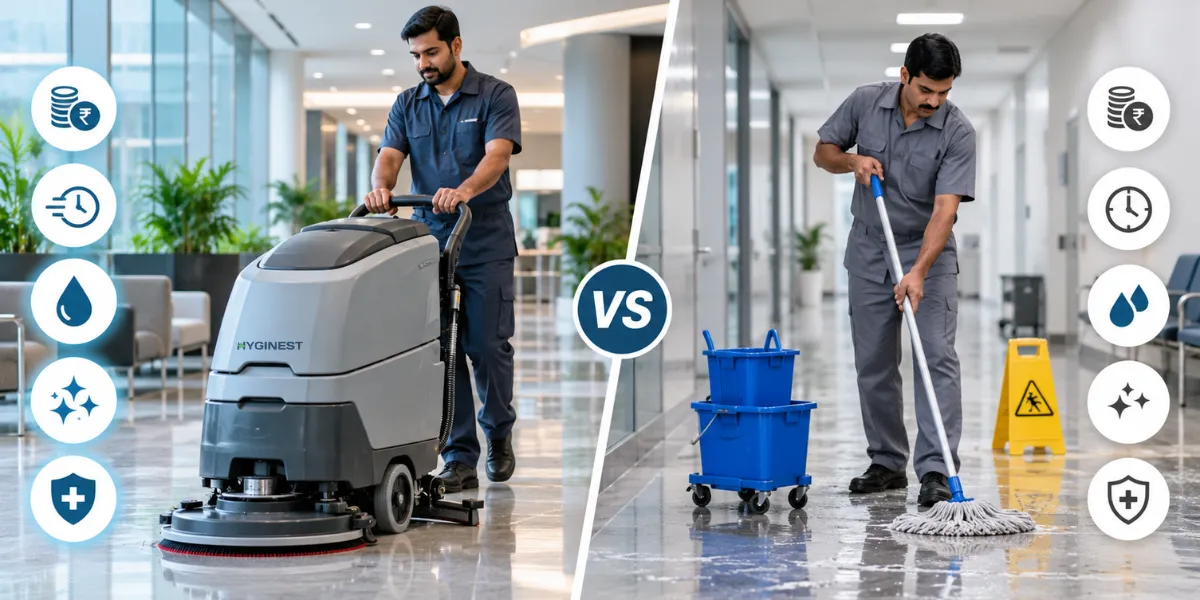
A commercial scrubber dryer costs more upfront than a mop and bucket, but it cleans floors faster, removes more bacteria in a single pass, and cuts labor hours enough to pay for itself within 12 to 24 months in most facilities that clean daily. Manual mopping needs a lower initial investment but redistributes dirty water across the floor, raises slip-and-fall risk, and needs more labor per square foot over time. For spaces under roughly 3,000 square feet cleaned a few times a week, mopping stays cost-effective. For daily cleaning above that threshold – warehouses, hospitals, food plants, retail floors – a scrubber dryer wins on both cost per square foot and hygiene outcomes.
A commercial scrubber dryer is a floor-cleaning machine that applies water and detergent, scrubs the surface with rotating brushes or pads, and vacuums up the dirty solution in a single pass. It replaces the separate steps of sweeping, mopping, and drying that manual cleaning requires, so the floor is walkable again within minutes.
How Much Does a Commercial Scrubber Dryer Cost Compared to Manual Mopping?
A scrubber dryer costs more to buy but less to run. Labor makes up 50% to 65% of total cleaning expenses at most facilities, according to ISSA’s financial forecasting report (February 2023), which means the machine that cuts labor hours the most usually wins the total-cost comparison, even with a higher sticker price.
A mop, bucket, and wringer setup costs a few thousand rupees and needs almost no training. A walk-behind commercial scrubber dryer costs significantly more upfront, but one operator covers roughly ten times the floor area per hour compared with a mop, which is where the savings build up. Hyginest sizes machines by tank capacity and cleaning path width so facilities only pay for the coverage they actually need.
Four factors drive the real cost difference between the two methods:
- Upfront equipment cost – machine price versus bucket, mop, and wringer
- Labor hours per shift – operators needed and time per square foot
- Chemical and water consumption – metered dosing versus manual mixing
- Maintenance and replacement parts – pads, brushes, and squeegees versus mop heads
“In cold-storage and pharma cleanrooms we service around Ahmedabad, sites that switched from bucket mopping to scrubber dryers reported fewer recontamination complaints within the first quarter, mainly because the machine never drags the same wastewater across the next section of floor.”
– Mehul Patel, Hyginest Industries
Which Is More Hygienic: A Scrubber Dryer or a Mop?
A scrubber dryer removes more bacteria from floors than a mop in most conditions, because it extracts the dirty solution instead of spreading it across the next section of floor.
Wet mopping alone adds little disinfection value beyond basic dust removal. A hospital floor sanitization study found dry dusting removed 81.9% of bacterial colonies while conventional wet mopping with disinfectant removed 83.1% – a gap the researchers judged not statistically significant, since the wet-mopping step added almost nothing beyond what dry dusting had already achieved.
More recent evidence points the same way. A small animal hospital cleaning study (March 2025) found that scrubbing brushes with detergent produced a more consistent bacterial reduction than damp microfibre mops, and floor samples cleaned by mopping were the only ones that stayed above the recommended safety threshold after cleaning.
Commercial Scrubber Dryer vs Manual Mopping: Side-by-Side Comparison
The table below lines up both methods on the factors facility managers weigh most, from mop buckets and trolleys on one side to walk-behind scrubber dryers on the other.
| Factor | Commercial Scrubber Dryer | Manual Mopping |
|---|---|---|
| Upfront cost | Higher (roughly ₹40,000–₹2,50,000+ depending on tank size) | Lower (₹1,000–₹3,000 for bucket, mop, wringer) |
| Labor per 1,000 sq ft | 1 operator, about 10–15 minutes | 1–2 workers, about 25–40 minutes |
| Bacterial reduction | Higher and more consistent across floor types | Lower, uneven, can spread contamination |
| Water use | Metered, controlled dosing | Reused across areas, higher cross-contamination risk |
| Slip hazard | Low – scrubs and dries in one pass | Higher – floor stays wet after mopping |
| Best suited for | Daily cleaning above ~3,000 sq ft: hospitals, factories, warehouses, malls | Small areas, spot cleaning, low-traffic rooms |
The break-even point for most Ahmedabad-area facilities running daily cleaning above 3,000 square feet falls between 12 and 24 months, once saved labor hours are weighed against the equipment cost.
Is a Scrubber Dryer Worth It for a Small or Mid-Size Facility?
A scrubber dryer pays off once a facility cleans roughly 3,000 to 5,000 square feet of hard floor on a daily basis. Below that volume, the labor savings take longer to catch up to the equipment cost.
Compact, battery-powered scrubber dryers lower this threshold for smaller Indian facilities. Hyginest supplies models sized for spaces as small as 2,000 square feet, which brings mechanized cleaning within reach of clinics, restaurants, and mid-size retail stores, not just large plants and warehouses. Facility teams comparing options can also check this hygiene compliance guide for related equipment decisions across a site.
Facilities under 2,000 sq ft cleaned twice a week rarely need a scrubber dryer. Facilities of any size cleaned daily on hard flooring almost always come out ahead with one.
What Mistakes Do Businesses Make When Switching to a Scrubber Dryer?
The most common mistake is buying a machine sized for the wrong floor area, which wastes both the purchase cost and the labor savings it was meant to deliver. Four mistakes account for most of the disappointment facility managers report:
- Skipping a floor-area and layout walkthrough before choosing tank size and cleaning-path width
- Ignoring pad or brush selection for the specific floor type, which cuts cleaning quality and pad life
- Under-training operators on daily maintenance – tank flushing, squeegee blade checks, filter cleaning
- Mixing chemicals by hand instead of using a dosing system, which wastes detergent and can damage floor coatings
Facilities running large open areas alongside detailed floor cleaning often pair a scrubber dryer with single-disk floor machines for periodic deep scrubbing and polishing, rather than relying on one machine for every floor task.
Frequently Asked Questions
Is a scrubber dryer worth it for a small office?
Usually not on its own. A small office under 2,000 square feet cleaned a few times a week typically gets more value from a mop and bucket or a compact single-disk machine than a full scrubber dryer.
How often should a commercial scrubber dryer be serviced?
Most manufacturers recommend a basic check after every shift (tank flush, squeegee, filter) and a full service every three to six months, depending on daily run hours and floor conditions.
Can a scrubber dryer replace mopping completely?
For open hard-floor areas, yes. Mops still handle edges, corners, stairs, and tight spots a machine cannot reach, so most facilities keep a mop for spot work alongside the scrubber dryer.
What floor types can a scrubber dryer clean?
Vitrified tiles, epoxy, vinyl, polished concrete, and most sealed hard floors. Textured or unsealed surfaces need matched pads and lower brush pressure to avoid damage.
How long does a commercial scrubber dryer last?
A well-maintained walk-behind unit typically lasts 7 to 10 years with regular servicing and timely pad, brush, and battery replacement.
Is manual mopping still acceptable for hygiene-sensitive areas like hospitals or pharma plants?
Mopping alone struggles to meet strict bacterial-reduction targets on large floor areas, based on the hospital studies above. Most hygiene-sensitive facilities pair a scrubber dryer for main floor areas with manual mopping only for edges and small rooms.
Final Thoughts
For daily cleaning of hard floors above roughly 3,000 square feet, a scrubber dryer earns back its cost through labor savings and delivers steadier hygiene results than a mop. Below that threshold, a mop and bucket remain a reasonable, low-cost choice for spot cleaning and low-traffic rooms.