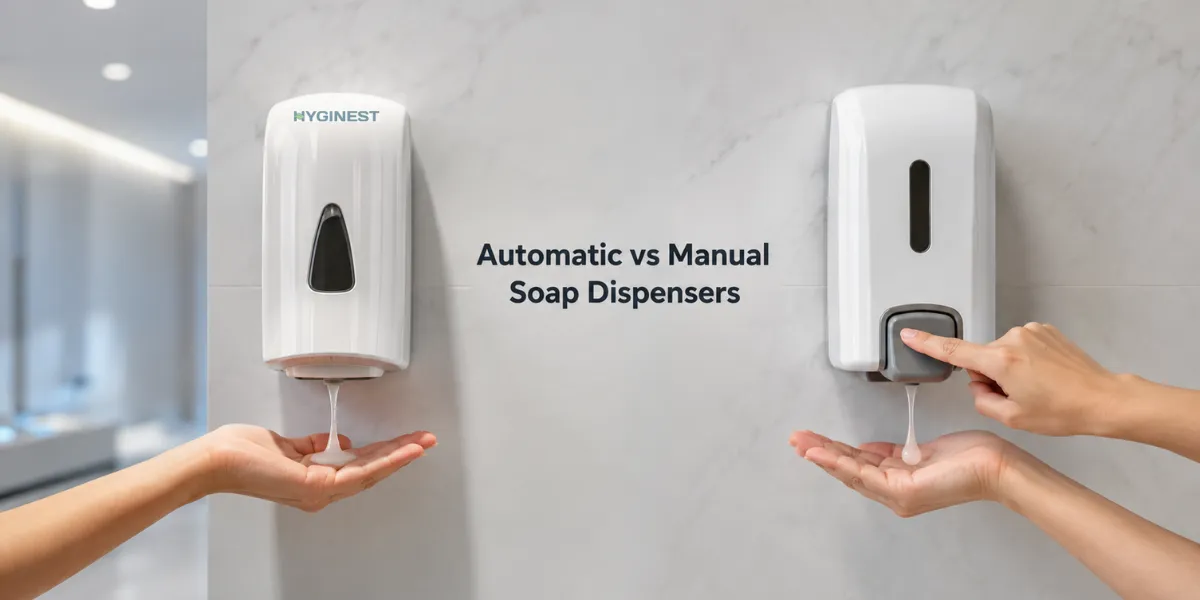
Automatic soap dispensers are the better choice for high-traffic or hygiene-sensitive spaces – offices, hospitals, restaurants, and airports – because touch-free sensors remove the shared touchpoint that spreads germs. Manual soap dispensers still make sense for low-traffic areas, home bathrooms, and tight budgets, since they need no batteries and cost less upfront. The right choice in 2026 depends on foot traffic and hygiene risk, not on which type is newer.
Automatic Soap Dispenser: a sensor-based unit that releases a fixed dose of soap when it detects a hand nearby, with zero physical contact.
Manual Soap Dispenser: a mechanical pump dispenser that releases soap only when a user presses the pump head by hand.
What’s the Real Difference Between Automatic and Manual Soap Dispensers?
The core difference is activation: automatic dispensers use infrared or motion sensors, while manual dispensers rely on a hand-pressed pump. Both release liquid or foam soap, so what actually changes is contact, dosing, and upkeep.
- Contact: automatic units need zero touch; manual units are touched by every user
- Dosing: automatic gives a fixed sensor-controlled dose; manual dose varies by how hard someone presses
- Power: automatic needs batteries or a power adapter; manual needs none
- Setup: automatic needs sensor calibration; manual just needs wall mounting
Hyginest’s touch-free soap dispensers are calibrated to release about 0.5 to 1 ml per activation, so dosing stays consistent across thousands of uses a month, unlike a hand-pumped unit where output depends on the user.
How Does Each Type of Dispenser Work?
Automatic dispensers run an infrared or capacitive sensor wired to a small pump motor. Manual dispensers use a spring-loaded piston that pushes soap out when pressed.
- Automatic: the sensor detects a hand within roughly 5–10 cm, triggers the motor, dispenses a set volume, then resets
- Manual: pressing the lever compresses a piston, which pushes soap up a straw tube and out through the nozzle
- Automatic refills: most units use sealed cartridges or bottles to cut leakage and speed up refills
- Manual refills: staff unscrew the pump head and pour soap directly into the reservoir
“In the pharma and FMCG plants we service around Ahmedabad, sensor drift is the most common automatic-dispenser complaint – not battery life. Wiping the sensor lens once a month solves most false triggers and misfires.”
– Mehul Patel, Founder & Director, Hyginest
Hyginest has fitted both manual and automatic soap dispensers across pharma, FMCG, and hospitality sites in Gujarat for more than 15 years, which is where this maintenance pattern shows up most.
Automatic vs Manual: Installation and Maintenance in 2026
Automatic dispensers take longer to install because they need sensor calibration and either a battery compartment or wiring. Manual dispensers just need two screws and a wall.
- Automatic: batteries typically need replacing every 6–9 months in high-traffic units, plus occasional sensor cleaning
- Automatic: the pump motor is the part most likely to need replacement after heavy daily cycling
- Manual: the pump head wears down over time but is cheap and quick to swap
- Manual: any staff member can refill or service it without technical training
Hyginest’s manual pump soap dispensers use a stainless-steel piston rated for well over 100,000 presses before the pump needs replacing, which is why they still suit low-traffic washrooms with tight maintenance budgets.
Automatic vs Manual Soap Dispensers: Full Comparison Table
The table below lines up both types across the factors that matter most when specifying washroom fixtures.
| Factor | Automatic | Manual |
|---|---|---|
| Hand contact | None – sensor-activated | Required – hand presses pump |
| Dosing consistency | Fixed, sensor-controlled | Varies by user pressure |
| Upfront cost | Higher (sensor + motor) | Lower (mechanical only) |
| Power source | Battery or adapter | None needed |
| Maintenance | Sensor cleaning, battery swaps | Pump head wear only |
| Typical lifespan | 3–5 years (motor/sensor limited) | 5–8 years (few moving parts) |
| Best for | Offices, hospitals, malls, restaurants | Homes, low-traffic or budget spaces |
Which Soap Dispenser Is More Hygienic in 2026?
Automatic dispensers are more hygienic because no one has to touch a shared surface to get soap. That single design choice removes one of the most-touched points in any washroom.
More than 61% of newly fitted premium commercial washrooms used touchless dispensing systems in 2025, up from 44% in 2021, according to Electronic Soap Dispenser Market Report (July 2026). That shift tracks directly with rising hygiene compliance requirements in offices, hospitals, and hospitality venues.
Sensor-based dispensing removes close to 90% of the hand-contact points a shared pump handle creates, which matters most in washrooms with 200+ daily users – hospitals, malls, and transit hubs.
Manual dispensers aren’t unhygienic by design, but the pump handle itself becomes a contact point that needs regular disinfecting, especially in food-service and healthcare settings where cross-contamination risk is higher.
Which Costs Less Over Time?
Manual dispensers cost less upfront. Automatic dispensers often cost less per year in high-traffic washrooms, because the fixed dose controls soap waste that a hand pump doesn’t.
- Automatic: higher purchase price, but consistent 0.5–1 ml dosing cuts overuse compared with an unmetered hand pump
- Manual: near-zero running cost beyond soap refills, with no batteries or sensors to maintain
- Automatic: fewer spillage-related refill trips, since dosing doesn’t depend on user pressure
Touchless alcohol-based dispensers do report higher rates of mechanical defects than mechanical pump models, according to a 2022 SHEA/IDSA/APIC hand hygiene update, so it’s worth budgeting for occasional sensor or motor replacement in high-cycle washrooms rather than treating automatic units as maintenance-free.
“Most of the washroom retrofits we handle in Gujarat swap failing manual pumps for automatic units in the highest-footfall areas first, then extend to low-traffic corners once the budget allows,” says Mehul Patel, Founder & Director at Hyginest Industries.
Which Should You Choose for Your Space in 2026?
Choose automatic for washrooms with 50 or more daily users. Choose manual for low-traffic or budget-first spaces where simplicity matters more than sensors.
- Offices, hospitals, hotels, restaurants, malls, airports: automatic – high footfall and hygiene compliance needs justify the sensor cost
- Home bathrooms, small offices, storage-room sinks: manual – low use makes the lower upfront cost the better trade-off
- Mixed-traffic buildings: automatic at main entrances and high-use restrooms, manual in back-of-house areas
A 20-seat café restroom and a 500-seat food court need different answers. The café can run a manual dispenser for years, but the food court will burn through manual pumps and lose hygiene compliance without sensors.
Many buildings that install automatic soap dispensers also add touch-free hand sanitizer dispensers and sensor-based taps at the same points, so the whole handwashing sequence stays contact-free from tap to soap to dryer.
FAQs: Automatic vs Manual Soap Dispensers
Are automatic soap dispensers worth it for a small office?
Only if the office sees regular visitor or staff traffic. For under 20 daily users, a manual dispenser usually costs less over its lifespan.
How often do automatic soap dispensers need battery changes?
Every 6 to 9 months in high-traffic washrooms, longer in low-use spaces. Rechargeable models can extend this further.
Can manual soap dispensers cause cross-contamination?
The pump handle can carry germs between users if it isn’t cleaned regularly. Wiping it down as part of daily washroom cleaning largely solves this.
Do automatic dispensers waste less soap than manual ones?
Yes, because the sensor releases a fixed dose every time. Manual pumps let users press harder or multiple times, which increases soap use.
What’s the average lifespan of a soap dispenser?
Automatic units typically last 3 to 5 years before the motor or sensor needs replacing. Manual units often last 5 to 8 years since they have fewer moving parts.
Can I install an automatic soap dispenser without rewiring my washroom?
Yes. Most commercial automatic dispensers run on batteries, so they mount directly on a wall without any electrical work.
The Bottom Line
Automatic wins on hygiene and consistency wherever a washroom sees regular foot traffic. Manual still holds its place in low-traffic or budget-constrained settings where simplicity beats sensors. As touchless adoption keeps climbing through 2026, expect more buildings to run both types side by side, picked room by room rather than building-wide.
Not Sure Which Dispenser Fits Your Washroom?
Talk to Hyginest’s hygiene specialists for a free site assessment – we’ll match automatic or manual dispensers to your foot traffic, budget, and maintenance capacity.
Get a Free Consultation →