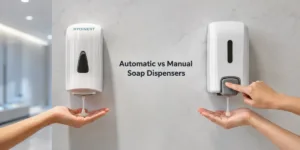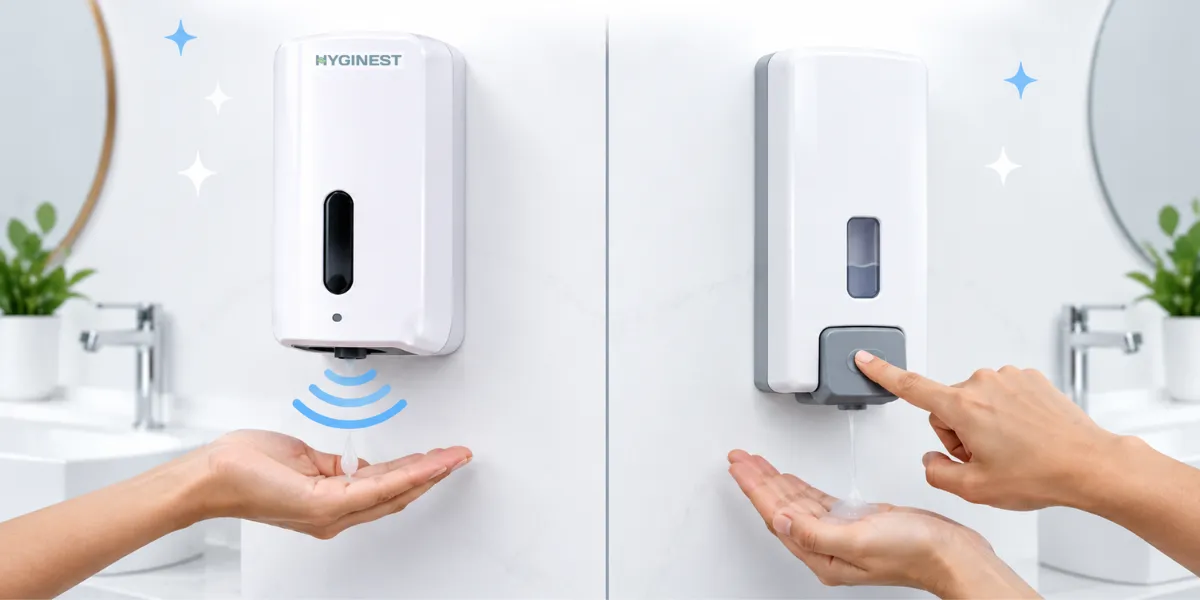
A touchless dispenser releases soap, sanitizer, or paper through a motion sensor with no physical contact. A manual dispenser releases product only when a user presses, pumps, or pulls a lever. Touchless units need battery or AC power; manual units run on mechanical force alone.
Touchless dispensers cut hand contact with washroom surfaces and, according to lab and hospital studies, carry meaningfully fewer bacteria than manual units. Manual dispensers cost less upfront, need no batteries, and fail less often. For high-traffic washrooms, clinics, and food facilities, touchless typically pays back its higher price within 12 to 18 months through lower soap waste and fewer service calls. For low-traffic or budget-tight sites, a well-maintained manual dispenser still delivers acceptable hygiene. The right pick depends on foot traffic, budget, and how strictly your facility must meet infection-control standards.
What’s the Real Difference Between Touchless and Manual Dispensers?
The core difference is the trigger. Touchless units read a hand’s presence through an infrared or ultrasonic sensor, while manual units release product only when someone presses, pumps, or pulls a lever.
This distinction matters because the WHO’s hand hygiene guidance treats every touchpoint – faucet handle, dispenser lever, or otherwise – as a possible transfer route for germs between users.
Facilities that pair soap and sanitizer with matching sensor-tap systems tend to standardize the whole washroom on one trigger method, so visitors don’t switch between touch and no-touch fixtures mid-visit.
How Much Do Touchless Dispensers Cost Compared to Manual Models?
Touchless dispensers typically cost more upfront than manual units, but the gap narrows once soap savings and fewer refill visits are counted.
A quality commercial touch-free soap dispenser generally runs $250 to $300, roughly double a basic manual unit. Facility teams tracking commercial installs commonly report breaking even within 12 to 18 months once soap savings and reduced maintenance calls are factored in.
At Hyginest Industries, the washroom hygiene catalog spans both touchless and manual soap dispenser models, so facilities can mix trigger types by budget zone rather than replacing an entire washroom in one pass.
Do Touchless Dispensers Actually Cut Down on Germs?
Yes – independent lab and hospital studies show touchless fixtures carry fewer bacteria than manual ones, though neither replaces proper handwashing.
Switching to a touchless faucet can lower microbe counts by as much as 98% compared with a manual faucet, per a Nordic water and materials institute study cited by tap manufacturer Oras. Manual faucet handles, by contrast, have been measured carrying an average of 127,000 bacteria per square centimeter in a 2004 International Journal of Food Microbiology study.
In healthcare settings, touchless fixtures cut surface bacteria counts by roughly 75%, per an American Journal of Infection Control-cited analysis. Manual units carry a separate risk: the CDC warns against topping off partially empty soap dispensers, since the practice has been linked to bacterial outbreaks (2024).
Hyginest’s soap dispenser range includes sealed-cartridge touchless models built to avoid that refill risk entirely.
What Maintenance Issues Should You Expect?
Touchless units need periodic battery changes and sensor cleaning; manual units need almost none but wear out mechanically over years of heavy use.
Battery-powered dispensers typically need new batteries every 6 to 12 months in high-traffic spots, budgeted around $5 to $10 per unit per year. Manual dispensers have fewer failure points and often last 5 to 10 years or more before replacement.
Facilities working with Hyginest typically stock spare batteries and a sensor-cleaning kit for every 10 touchless units, based on service patterns tracked across washroom, cleanroom, and entrance installations.
Touchless vs. Manual Hygiene Dispensers: Which Dispenser Type Fits Your Facility?
High-traffic, health-regulated, or image-conscious sites should default to touchless; low-traffic or tight-budget sites can rely on manual.
| Attribute | Touchless Dispenser | Manual Dispenser |
|---|---|---|
| Upfront cost | Higher (avg. $250–300 per unit) | Lower; basic pump units cost far less |
| Power needs | Battery or AC required | None – mechanical only |
| Typical lifespan | 3–5 years (sensor wear) | 5–10+ years |
| Hygiene edge | Removes the contact point entirely | Depends on user technique and cleaning |
| Best fit | Hospitals, food service, high footfall | Small offices, low-traffic or tight-budget sites |
Many facilities mix both: touchless soap and sanitizer at wash points, manual pumps in low-traffic corners, and a matching paper dispenser lineup to keep the whole handwashing station consistent.
FAQ: Touchless vs. Manual Dispensers
Is a touchless dispenser worth it for a small office?
Usually not for very low foot traffic. The soap-saving and hygiene upside is smaller when only a handful of people use the washroom daily, so a manual unit often makes more financial sense.
Do touchless dispensers work during a power cut?
Battery-powered models keep working; AC-powered models stop until power returns. Battery units are the safer default for sites with unreliable grid power.
Can I retrofit manual dispensers to touchless later?
In most cases, yes. Wall-mounted brackets are usually compatible, so facilities can upgrade dispenser heads without redoing plumbing or wall fittings.
How long do dispenser batteries actually last?
Typically 6 to 12 months in high-traffic washrooms, less in very busy sites. Alkaline batteries are generally recommended over rechargeables for consistent sensor performance.
Do health codes require touchless dispensers?
Rules vary by region and facility type. Many health departments recommend or favor touchless dispensers in food-service and healthcare settings without always mandating them outright.
Which option saves more soap over time?
Touchless dispensers generally waste less because sensors release a fixed, controlled dose. Manual pumps depend on how hard or how often a user presses the lever.
Still Deciding Between a Touchless and a Manual Dispenser?
Hyginest matches the right dispenser to your washroom, traffic, and budget – with free consultation and pan-India installation support.
Buy Touchless Hygiene Dispenser →